
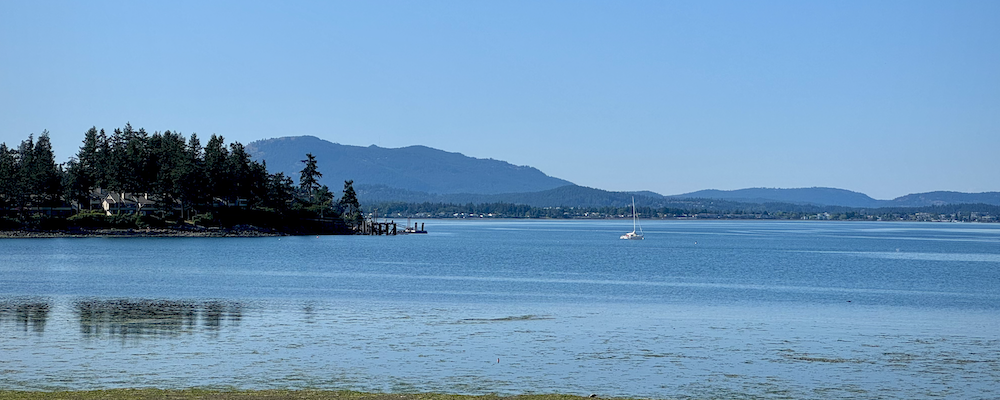
When I registered for my very first half-Iron distance at a race in Germany in 2018, it felt like a major challenge with unknown outcomes. Back then I wasn’t even sure yet whether this longer distance triathlon thing was for me at all, never having done anything more than just a couple of super-sprint tris. Finishing Ironman 70.3 Kraichgau in 2018 eventually had changed my athletic life and ever since I mainly focused on full Ironman races, competing in eight such competitions, including a world championship event last year.
My last Half-Ironman took place two years ago, and when a friend of mine asked me to join him participating in Victoria this year I did not have to think twice. After racing so many long events, the half distance suddenly feels much less daunting than it did eight years ago, and with a very good base fitness I was sure I’d be able to enjoy the event. After all, it’s happening on Vancouver Island! There’s hardly a better place to race in the world.
Travelling to Victoria
For once there is a place with direct flights from my hometown of Ottawa. Getting to Victoria and finding a place to stay was relatively easy. The race venue is centered around Elk Lake, which is halfway between the airport and downtown. I decided for a motel close to both, the airport and the swim start; this allowed me to even walk my luggage to my accommodation (around 5km total), and ride my bike to the pre-race duties like athlete briefings and bike check-in (another 7km).
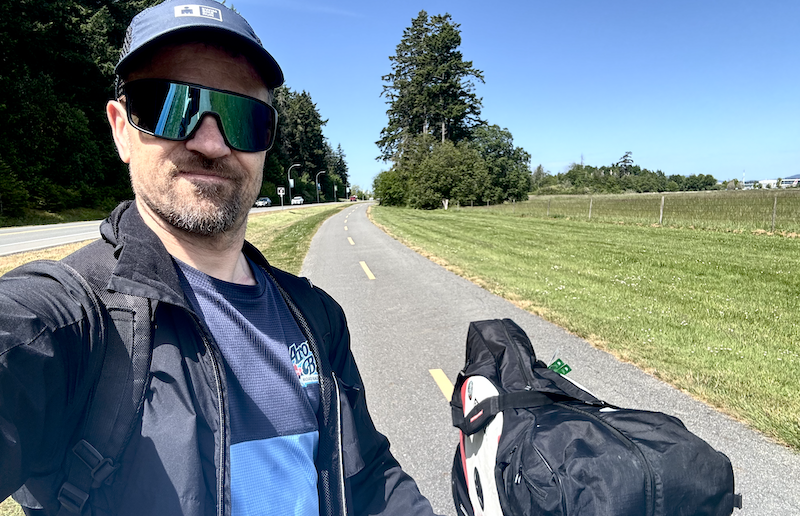
With the event not directly taking place in the city itself, I did not experience those typical Ironman vibes outside of the athlete village on Elk Lake. This was a big difference to events like the ones in Lake Placid, Mont-Tremblant, Penticton, and even Ottawa.
The venue and race setup
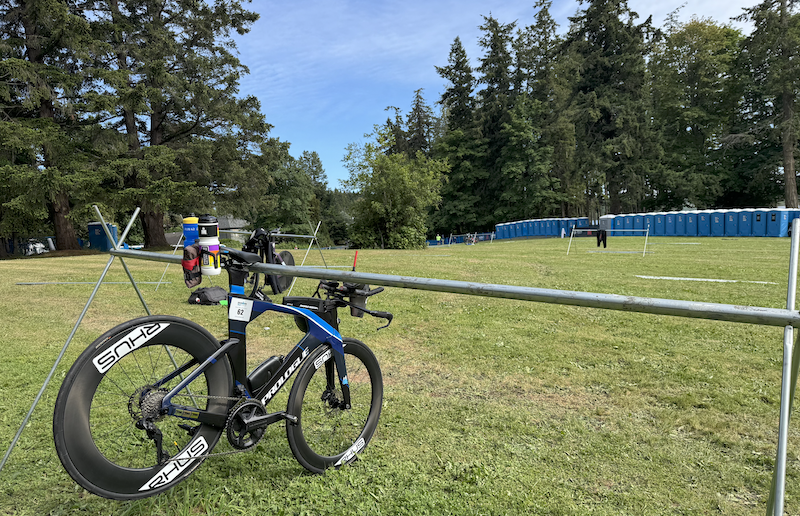
Ironman athlete village was located in a beautiful park right next to Elk Lake. Lots of shaded, grassy areas, a sandy beach, large trees, easily accessible by bicycle. The race is organized as a one transition race, meaning that all three disciplines start and finish in the same location. This makes organizing your race so much easier. It only was a bit tight; without any transition bags (like it is done in full distance events), every athlete had to place any gear they would need in transition right next to their bike (things like bike and running shoes, towels, sunscreen, helmet, wetsuit after the swim, etc.).
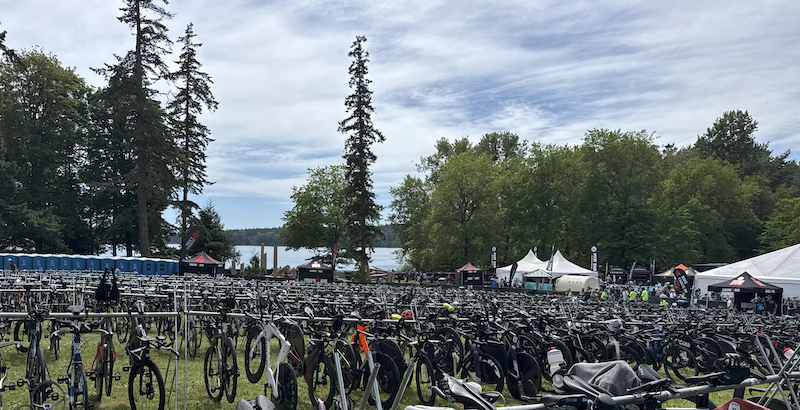
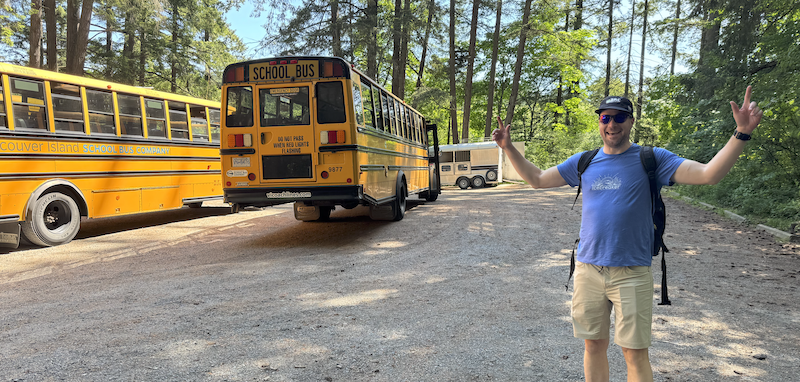
The days leading up to the event were gorgeous and exploring the area by bike while and running had been a blast. For race day, the forecast predicted cooler weather and clouds.
And while I am not the biggest fan of swimming, it was good to hear that this year the swim would go ahead. Unlike 2025, when a bad algae bloom forced the organized to cancel the swim portion altogether. Coming from a long, cold winter in Ottawa, all my swim training happened indoors, and getting at least one short open water swim in before the race was very valuable.
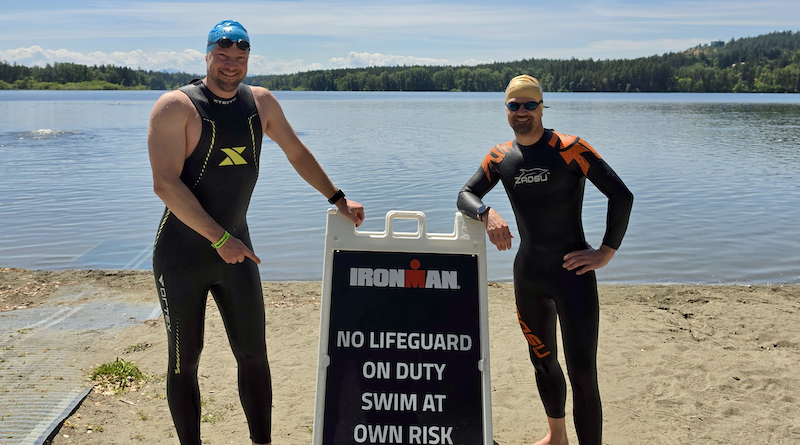
Race morning
After a pretty good sleep I woke up at 3am, 15 minutes before my alarm was going to go off. Some fellow athletes I met the day before were kind enough to offer giving me a ride to the venue at 4:30, which gave me enough time to go through those race morning routines; mainly coffee, forcing down breakfast calories, countless washroom visits, double-checking my gear, and once again going through my nutrition plan.
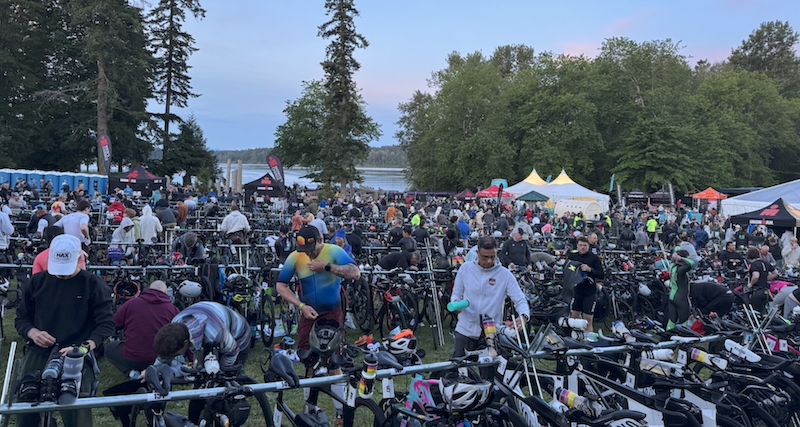
We arrived at transition just before 5am, with enough time to prepare for the start: filling up your water bottles, checking tire pressure, placing your calories on the bike, calibrating power pedals, turning on bike computer and acquire satellite signals, getting into the wetsuit, and wishing my friend good luck on his own race. It was cold that morning. At 9ºC air temperature the last thing you want to do is go for a swim, and not even the neoprene on my skin helped to warm me up at this point.
The vibes were great, though, and after collectively listening to Oh Canada, Ironman 70.3 Victoria was on!
Swim: 1900m in 36 minutes
At 18ºC, the water was twice as warm as the air. Still cold on your feet, and face, and hands, and when I entered the water after around twenty minutes of waiting within the 35-40 minutes corral, I was a bit concerned of getting another minor panic attack like I did on my last Half-Ironman in Muskoka.
Luckily, the swim start was not stressful at all and there was enough space for everyone to spread out. That allowed me to get into my rhythm, not having to fight for position or direction. After about 5 minutes I was doing a steady pace, not feeling cold at all anymore. The lake was not the clearest, but it was calm, no waves, no wind, and the buoys were very visible. The course itself was a straightforward out and back, with two 90º turns at the halfway point.
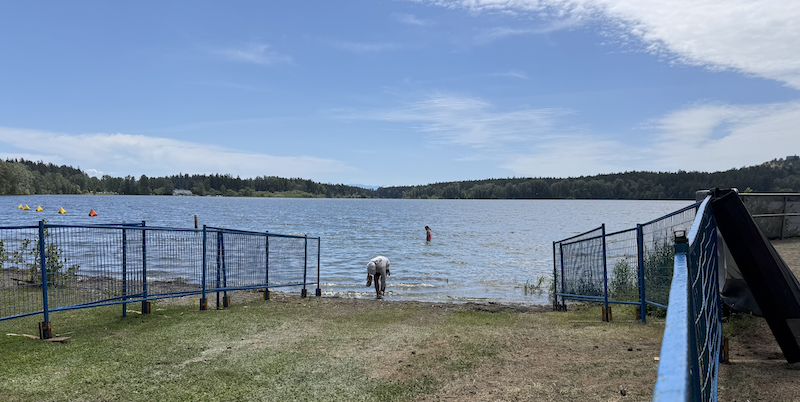
Every 500m I checked my pace and was surprised about myself going well under 2min/100m. Turns out that regular pool visits do actually help getting faster! After 36 minutes I finished that overall uneventful and calm swim a minute faster than my previous best, and struggled my way back into transition. Wetsuit off, quickly drying up feet, upper body and head with a towel, putting on cycling jersey and wind vest, putting on sunscreen, socks, shoes, helmet, gloves, sunglasses. After six minutes I was in the saddle.
Bike: 90km in 2h35m
It was now time to warm up quickly, to enjoy my favorite discipline! It was still pretty cold outside (10ºC), but sunny without too much wind that early during the day. The course promised to be a tough one, with a total elevation of around 1000 meters, most of which disguised as rollers, but with plenty of turns that often kill the downhill momentum.
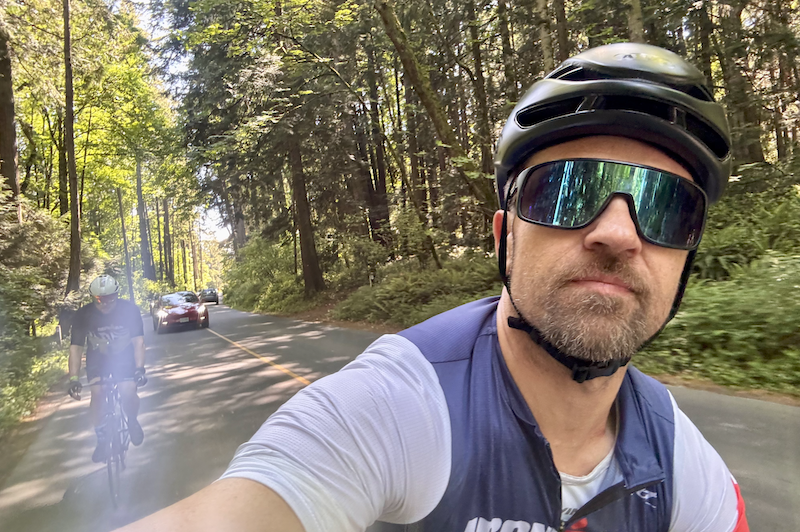
Right out of the gate I was having a blast. My swim may have been fast compared to myself, but not compared to the overall field, so I had plenty of folks ahead of me to pass. For the entire course I was passing people, and not a single cyclist overtook me. My legs felt great, I stayed in aero position for most of the course and kept pushing with a normalized power of 3.5 watts per kilo; a bit of a gamble, but it never felt too much and helped me to stay close of my 2.5 hours goal.
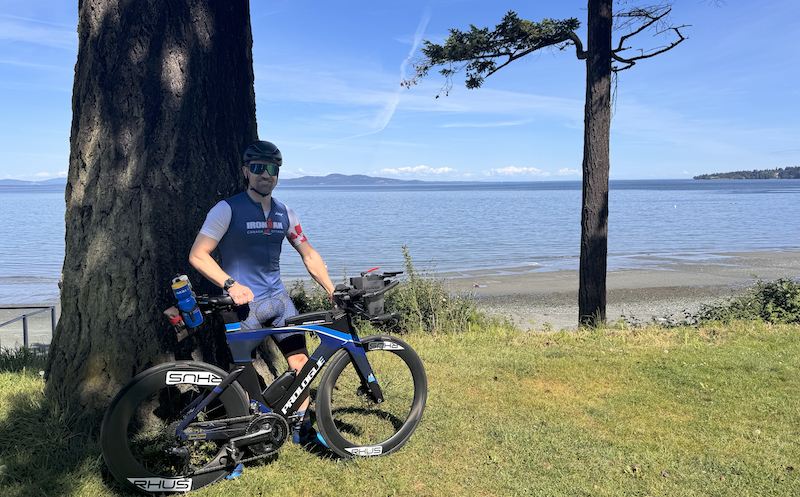
The course was designed as one single loop. This always helps to spread out the field, and in an area like Vancouver Island really lets you see as much of the area as possible. So many great views of ocean and mountains, long stretches through forests and along beaches. It never got boring. The asphalt was rough in some parts, and unfortunately most roads weren’t closed off to cars, but the race marshals and volunteers did a great job making it as safe as possible. I’ve had much worse (I’m talking to you, Muskoka!).
Every 25km there was an aid station, providing water, nutrition (electrolyte in bike bottles, Maurten 100 gels, and bananas), but my strategy was to skip all of that, and instead keeping my momentum feeding on what I had with me: 90g of carbs per hour and just under 2 liters of fluids. Every 15 minutes a good sip of Tailwind-water-mix, and a Maurten gel every 45 minutes. That kept me energized and hydrated for the whole distance, which I finished in 2h35m – a couple minutes longer than my PB, but on a considerably harder course.
Run: 21.1km in 1h34m
For the last part I had zero expectations other than doing a solid, consistent run. The past year my training was mainly focused on cycling, leaving not too much time for high running volumes. With my long running background, a half marathon didn’t feel daunting either, though, I just hadn’t done longer runs in a while. Coming off the bike I felt surprisingly good, jugged down another gel, and exited transition.
The course (2 loops around Elk Lake) itself was a big surprise to me. I knew it was going to be a gravel surface, but I did not expect running on actual trails, with roots, and rocks, and steep single track turns around trees! With already somewhat tired legs, watching your footing became the main priority. After my fast bike section, not too many runners were out on the course yet, and the first loop was not too crowded.
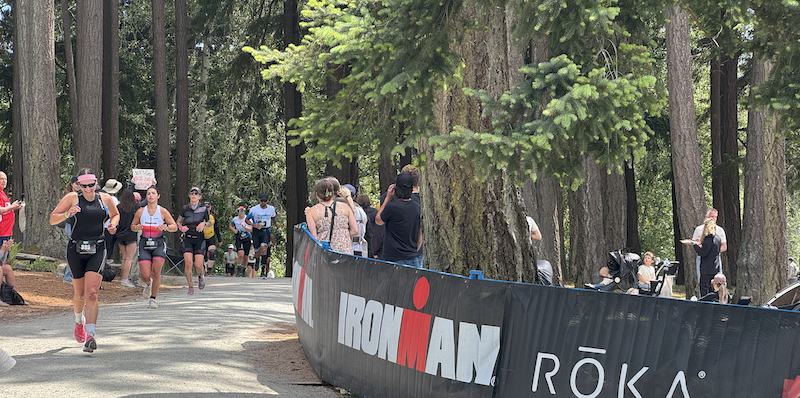
After the first kilometer, my watch told me a pace of 4:20/km. It felt good but was much faster than anticipated. Yet, I decided to keep going at that speed, accepting the fact that I’d be slowing down at some point. Kilometer after kilometer I reevaluated my effort and each time decided I could keep pushing. Every 10 minutes I refueled at each of the water stations, with either a gel and water, or an electrolyte drink. That strategy seemed to be working perfectly. While I was getting more and more out of breath, I was able to keep my initial pace for 2/3 of the run, only slightly slowing down to 4:30/km for the final couple of kilometers.
Like on the bike, I mostly passed others, hand hardly got passed myself. That’s always a great confidence boost, but the second loop felt really hard. My Garmin heart rate display got stuck at 151bpm right from the start, and I’m sure my heart was beating faster than that for most of the run.
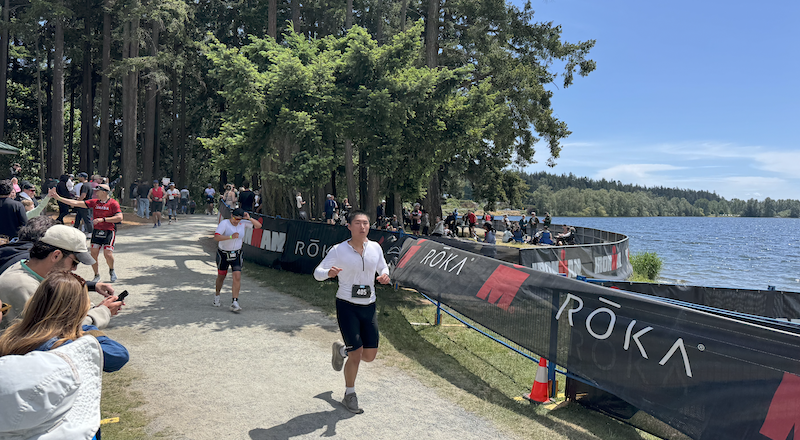
I did like the run course, though. Good views of the lake, plenty of shade, and a handful of people cheering in the middle of the woods. Passing by the finish area after the first loop provided some needed motivation to keep going and then realizing that I managed to stay well under 5 hours at the finish line felt great! I did push hard for the entire run, but it was worth it. I now had finished half as many Half-Ironmans as full ones. That sounds appropriate.
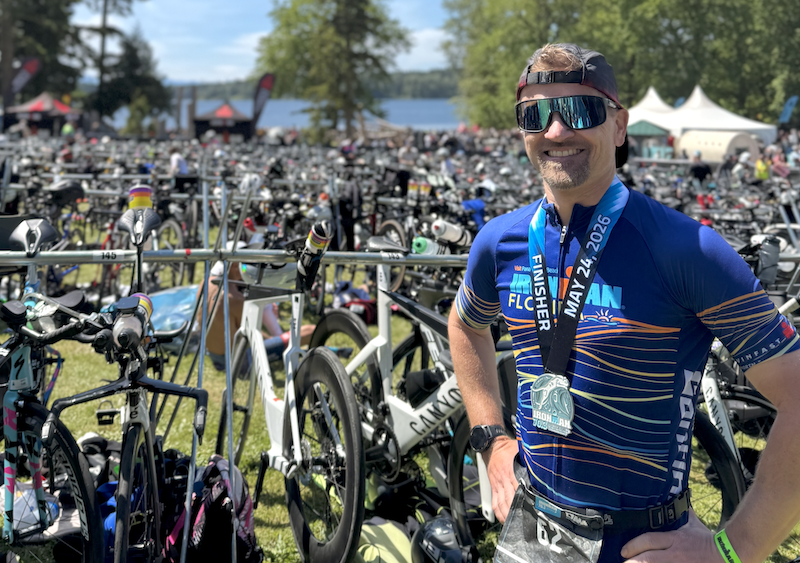
Qualified for worlds!
This was my first Ironman race where my overall finish time actually qualified me to participate in the IM 70.3 World Championship without a roll-down. Age-adjusted, I ranked on 34th place overall (out of 880 male finishers), and 35 slots were available. But the Worlds happened to be held in Nice/France this year, and I just went there for last year’s full Ironman World Champs; plus, my summer’s already full of other adventures anyway! I declined.
Statistiken
Some stats compared to my personal best in Muskoka 2024:
- Swimming 1.9km: 36min (-3min)
- Wechselzone 1: 6min (+/- 0min)
- Cycling 90km: 2h35min (+6min)
- Wechselzone 2: 4min (+/- 0min)
- Running: 1h34min (-1min)
- Total time for 113km: 4h55min (+2min)
Nutrition strategy and consumption:
- Breakfast: Coffee, chocolate chip muffin, 1 banana
- Pre-swim: 1 banana, 300ml electrolyte drink
- On the bike: 700ml water in front hydration system; 500ml water + 300cal of Tailwind in center; 700ml + 300cal of Tailwind in back, 3xMaurten 100 gels.
(total of 225g carbs = 90g/hour; 1900ml water = 750ml/hour) - On the run: 200ml electrolyte drink and 1x Maurten 100 gel in transition, 3x Maurten 100 gels and 3 cups of water during the run, 4 cups of electrolyte drinks
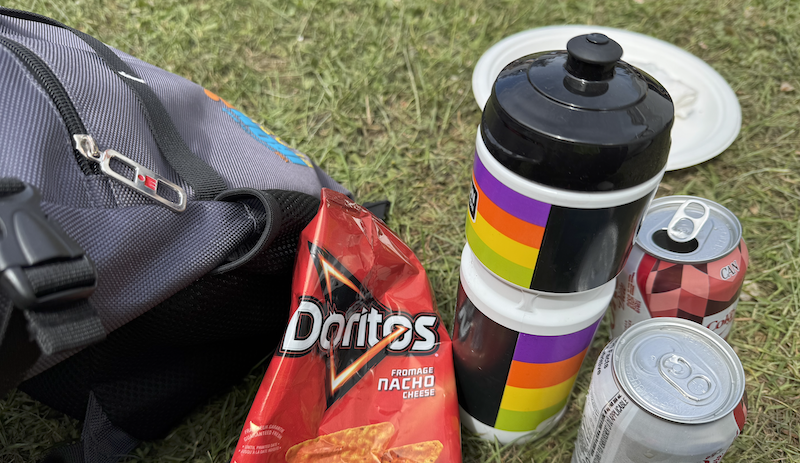
(total of 100g carbs = 65g/hour, 550ml water = 350ml/hour) - Post-race: 1200ml water, rice-chicken wrap, 2 packs of chips
Nachbetrachtung and tips
- IM 70.3 Victoria is a race to recommend. Easy travel and accommodation, scenic and mostly safe bike ride, single transition setup, great lake swim, very unique run
- You don’t necessarily need to rent a car. Getting around with Uber or on your bike is convenient enough. On race morning you will very likely find someone who can give you a ride to the start.
- Familiarize yourself with hilly rides on an aero bike. The downhills are fast, some of the climbs are quite steep. The one-loop setup ensures a non-crowded course. Cars can sometimes be a small annoyance especially towards the end of the ride.
- Don’t believe the Ironman course classification… I’d consider the bike portion hilly (not just rolling), and the run course rolling (not flat).
- Bring clothes for cold and warm weather. I’ve heard that in years before it was much colder, it could rain, but it could also get quite warm. The forecast is not always too reliable on an island, especially not a couple days out when you start your travels.
- Come a couple days before the race and explore the beautiful area on your bike. Most of the bike course can be ridden before race day. The lake is open to training swims.
- Be prepared for a technical trail run. It is fun and keeps your mind occupied, but definitely not as fast as running on asphalt.