
Gesamtbewertung: 8/10 Detailbewertungen am Ende des Berichts | Vergleich aller Wettkämpfe
Since I moved to Canada, I’ve done multiple marathons in my new hometown of Ottawa. When I learned that my birth town was about to organize its first long-distance running event in many years I couldn’t register fast enough. The inaugural Chemnitz Marathon 2025 turned out to be such a great way to see the town I grew up in from a runner’s perspective.
An endurance experiment
This was going to be my second marathon this year, after completing the Embrace Winter Marathon in Ottawa a couple months ago, fighting fierce winter conditions. I haven’t been out running too much ever since, and my training this year has been focusing much more on cycling. The trip to Germany itself was going to be mainly a bikepacking adventure, with the marathon somewhat of an endurance experiment: how would my body cope with a running race, after having mostly trained on a bicycle?
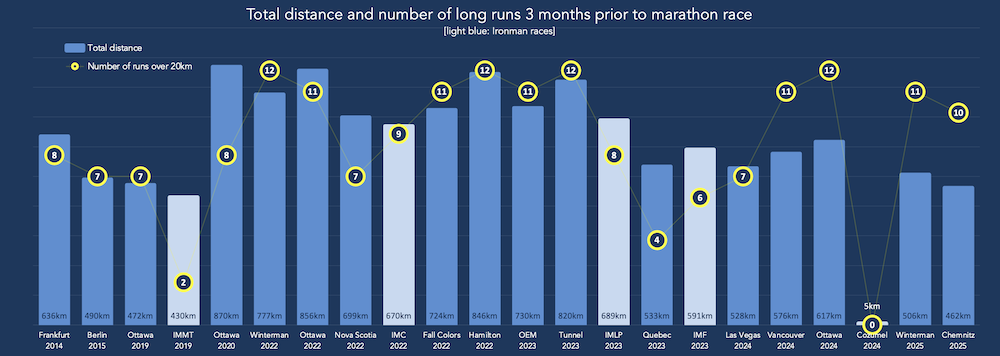
During the three months prior to the event, I only ran a total of 462 kilometers. This is less of a training distance than any of my previous standalone marathons. In contrast, I had cycled many thousands of kilometers already, more than ever before that time of the year. The decision to incorporate marathon running into a multi-week cycling adventure came somewhat naturally and I felt confident in years and years of marathoning experience.
Chemnitz: European Capital of Culture
Chemnitz has not had a marathon in many years. But in 2025, the town was selected the role of European Capital of Culture – reason enough for the organizers to bring long-distance running back to town in form of the Kulturhauptstadtmarathon (Capital of Culture Marathon). And for me reason enough to plan a longer vacation in Europe around race day.
Taper week = lots of cycling
Marathon training is usually structured in multiple phases. The last of which often referred to as tapering: For the days and weeks prior to a main running event athletes significantly reduce their training load and intensity allowing their bodies to rest and recover and be in their best shape come race day.
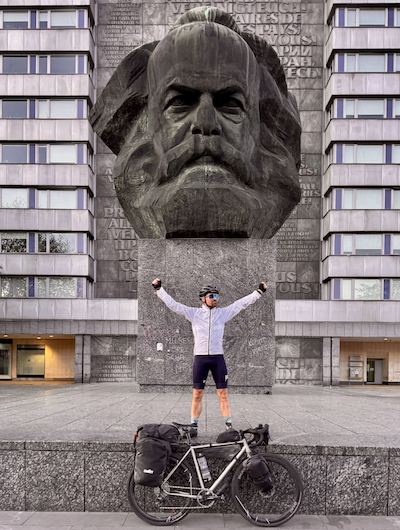
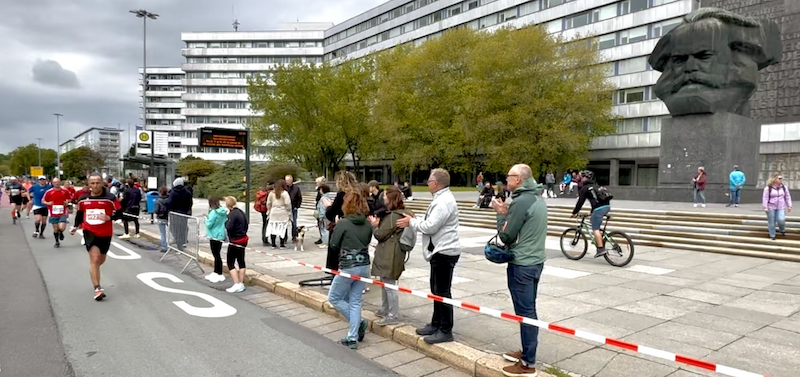
For Tara and me, taper week looked much different: Since we wanted to cross all of Germany by bicycle, we started our trip up north in Lübeck, and gave ourselves 3.5 days to cover some 550 kilometers towards Chemnitz with two days to spare prior to the marathon. We really enjoyed those first long traveling days in the saddle – starting at the sea, then following the Elbe River south-west, before cutting south into the Erzgebirges. region (Ore Mountains). My hometown’s most iconic landmark, the Karl-Marx-Kopf, welcomed us on Thursday evening, just before we checked-in to our accommodation; an apartment only a block away from where I spent most of my teenage years.
Pre-marathon routines
After picking up our bib numbers and event shirts on Saturday morning, we enjoyed a pasta lunch that was offered by the race organizers. Not many running events seem to be doing this anymore these days! The marathon expo itself was relatively small and not too much to see or explore. Most interestingly there were no vendors offering race nutrition – in North America, you’ll see dozens of options being offered during the expo; anything from gels and bars to powders and tablets to both prepare you for and get you through the race. Not in Chemnitz; I wasn’t even able to find specific nutrition in the sports stores close-by and had to figure out an alternative plan for race day.
That evening we visited an old high school friend of mine, who invited us to another pasta meal. He was going to run the half marathon tomorrow, and it was good to not only catch up on old times but also talk race strategy and course specifics.
The course around my home turf
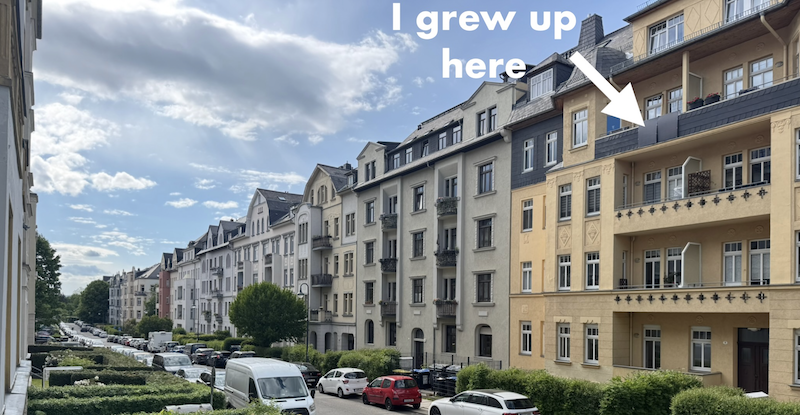
I was born in Chemnitz – or in Karl-Marx-Stadt rather, which was the name of that town during most of the cold war area until the early 90s – and spent the first 18 years of my life there. As a child, and later as a teenager, I explored that city extensively by foot or bicycle. Today, there are around 270,000 people living in Chemnitz but it feels like a much bigger town; especially when you’re used to North-American standards. Thanks to its typical European urban design and a high population density, along with a functioning and well-used public transportation system, Chemnitz feels much more lively compared to similarly sized Canadian towns (which is true for any of the smaller towns we visited while being in Germany).
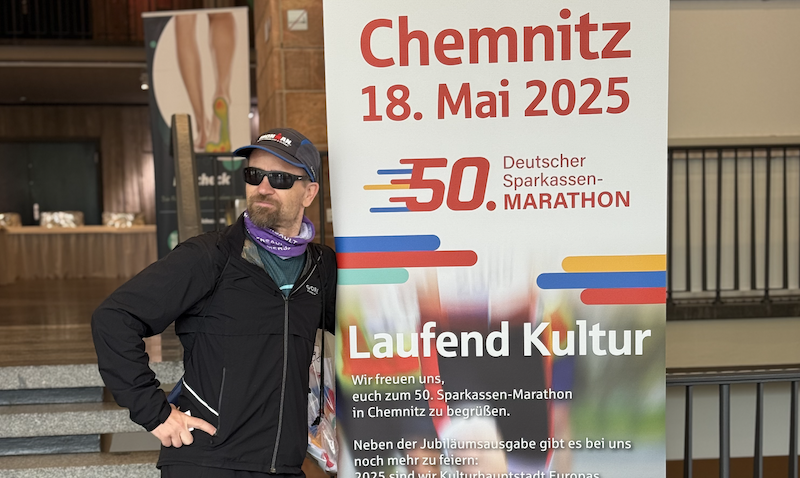
While many things have changed in Chemnitz since I moved away more than 25 years ago, everything looked still very familiar. I was looking forward to run the marathon course: Starting in downtown, just across city hall, going west around the Stadtpark (city park), back into town, around the Schlossteich (castle lake), all the way to the Küchwald (a recreational forest area) in the west, and then back via Chemnitz’ two most iconic sites: the Bunte Esse (a tall power plant chimney painted in different colors) and the Karl-Marx-Kopf (a tall bronze monument showing Karl-Marx’ head). The course consisted of two loops, making it rather easy to break down into individual sections.
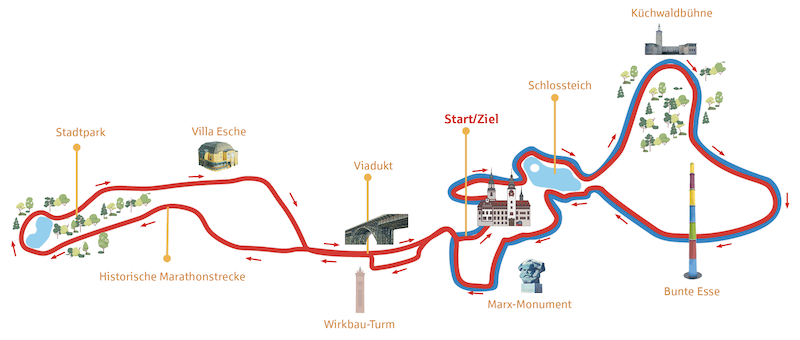
Image from event website.
This event was going to be one of my fun marathons, where finishing time did not matter too much to me. Having not had a lot of structured training, my main goal was to enjoy the course, take in the vibes, and run at a consistent, sustainable pace from start to finish.Chemnitz is small enough to be a quite walkable town, which allowed me to walk to the marathon start on a cool but sunny Sunday morning. The race was going to begin at 9am sharp.
Loop 1
Around 1000 runners had registered for the marathon distance, and many more gathered around the starting line spectating their hometown’s first large running event in years. I was surprised how many people showed up and the atmosphere on race morning was quite something!
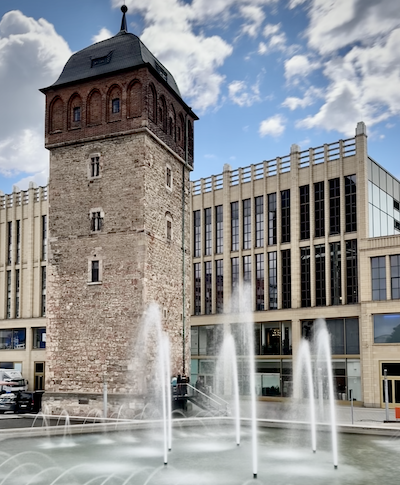
What a special feeling to start a marathon in your home town, after having been away for so many years. Full of endorphins I got going, zigzagging my way around the first couple hundred meters on rather narrow roads. Soon enough the field of runners thinned out a bit and I was quickly able to settle into my pace. With no specific goal in mind, I went for what I knew would be a conservative and sustainable pace and tried to keep it between 4:35 and 4:45 minutes per kilometer.
The course had us run south, out of the downtown area into calmer neighborhoods and along the Chemnitz river into the Stadtpark (city park). Mostly asphalt, some soft gravel, and all pretty flat. Chemnitz is a very green town, and most of the route was well-protected from the sun by luscious tree covers.
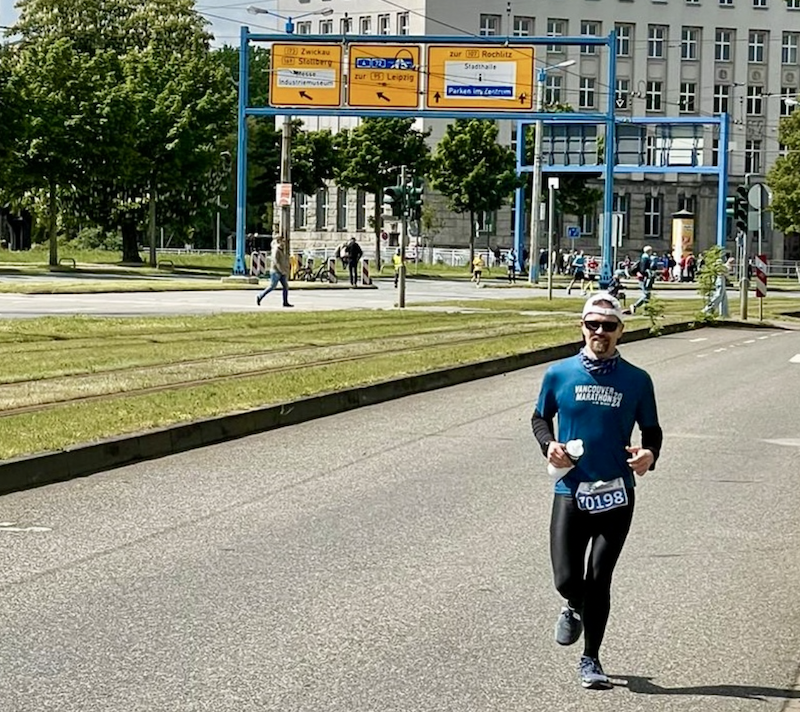
After five kilometers we reached the southern-most turnaround point, turning back north. Every two kilometers or so there was a water station and I took advantage of every single one of them – realizing that all they offered was water or coke. Good thing that I was also carrying a bottle with 500 calories of Tailwind diluted in water. My speed had not dropped by kilometer 10 and I generally felt pretty good; some doubts entered my mind though, whether or not I’d be able to sustain that 4:40min/km pace throughout the remaining three quarters of the race.
It was an uplifting surprise when I suddenly saw my dad and my cousin cheering me on from the sideline; what a way to meet your family again after more than two years! I figured they’d understand that I wouldn’t be in the right mindset for a chat at this point and kept on going. The beauty of this event’s loop design was that spectators could meet their athlete easily at different points of the course.
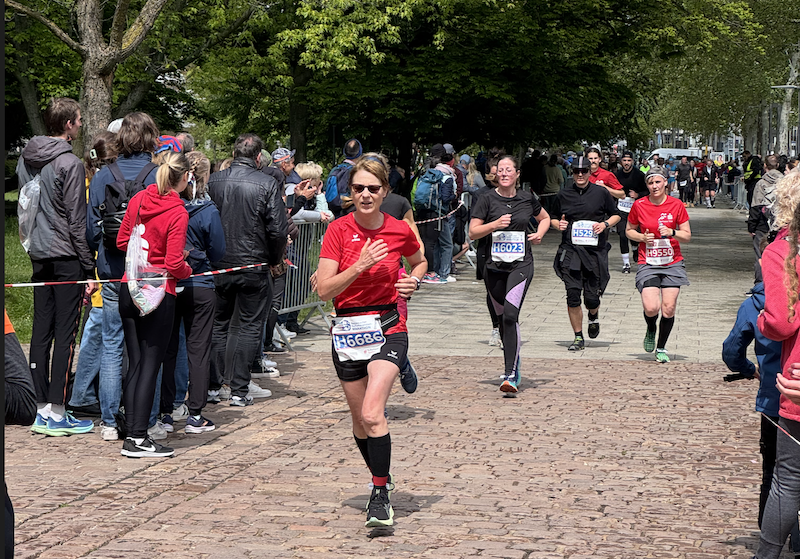
At kilometer 13, still on the first loop, the route had us going up a short but steep hill which came somewhat unexpected; suddenly I found myself struggling to keep running at a 14% incline. Instantly my heart rate rose up, pace went down, and after just those 2-3 minutes of extra exhaustion it took a while to get back into a rhythm. While continuing on calm forest roads through the Küchwald I tried to mentally prepare for a second time up that hill on the next loop.
Overall, there were quite some good pockets of spectators along the course, but it really got busy when we moved back towards city center. Probably thousands of folks cheering and applauding over the final kilometers of the first loop gave me some good extra energy to start the second one. I crossed the half way point at 1h38min into the race.
Loop 2
A two-loop course setup can help breaking down the marathon into smaller chunks, but it also can make you feel overwhelmed; you pass the finish line knowing that you’d have to do the whole thing once again. With a consistent and sustainable heart rate of 160bpm I was still feeling surprisingly well. I kept running through the water stations, taking at least a couple sips of water and coke. My bottle of Tailwind mix was about half empty.
It was around kilometer 30 when the first struggles started; not that this came as a surprise – each marathon race at some point tries to break you either physically, or mentally, or both. I’ve had events where this point was reached much earlier. I was ok with 12 kilometers left; mainly my feet were causing some issues, starting to blister up a bit, while conditionally I still felt good.
The real challenge came at kilometer 34, when I had to conquer that steep hill for the second time. I slowed down massively, but never walked. Maybe I should have, since I’d never recover from that energy-sucking little incline for the rest of the race. My heart rate spiked at 180, my average pace went down to around 5 minutes per kilometer for a while. My mood stayed positive though, and soon I knew that this was going to be a respectable marathon result, with the final 6 kilometers mainly being downhill, towards downtown, and without having to deal with any serious issues. Only my quads started screeming “Stop!” and I just hoped that they’d hold up for those remaining 15 minutes!
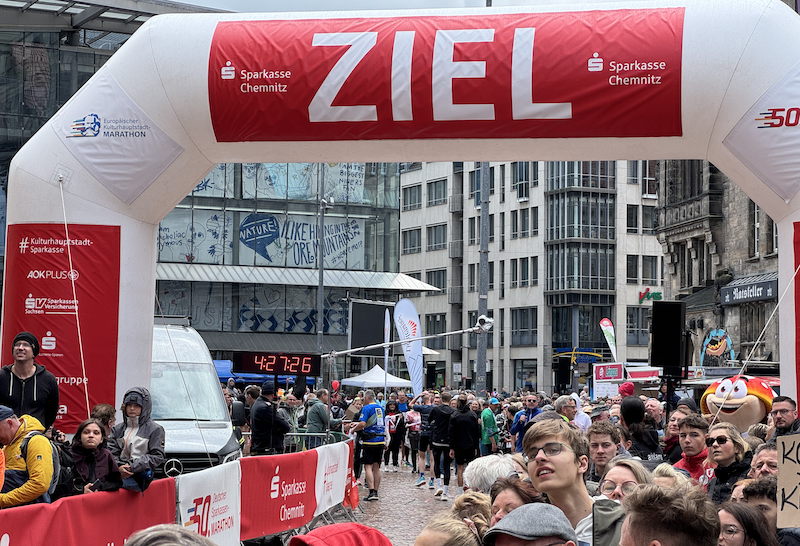
Crossing the finish line after 3 hours and 16 minutes on the run felt incredibly rewarding – thousands of spectators, a familiar environment, and a successful run without completely burning out.
Nachbetrachtung
- Marathon #24 in the books!
- Chemnitz did a great job putting up their first marathon in years. Good organization, reasonable price, great vibes, good communication
- Plenty of water stations but not well equipped aside from water and coke. I would have appreciated some options of gels and electrolyte drinks
- Running a reasonably fast and consistent marathon is possible even without any structured training and in the middle of a bicycle tour – if you got enough race experience and base miles
- Next up: Ironman Ottawa in August!
Statistiken
Gesamtstrecke: 42.2km
Gesamtzeit: 3h16m (compared to 3h04m personal best)
Herzfrequenz: 165bpm
Gesamte Höhe: 200m
Verbrannte Kalorien: 2800
Konsumierte Kalorien: 700
Flüssigkeit aufgenommen: around 1000ml
Temperatur: 10ºC, mostly cloudy skies
Total number of registered runners: around 1000 for the marathon
Chemnitz Marathon Chemnitz, Germany | |||
Overall rating | |||
 | 2025 |  | 1000 |
 | Spring |  | 2 Runden |
 | 9:00AM |  | Rolling (200m) |
 | 10ºC |  | Asphalt |
Individual ratings* | |||
Spectators | Scenery & views | ||
On-course nutrition | Overall organization | ||
Medal design | Finisher shirt | ||
Timing and splits | Value | ||
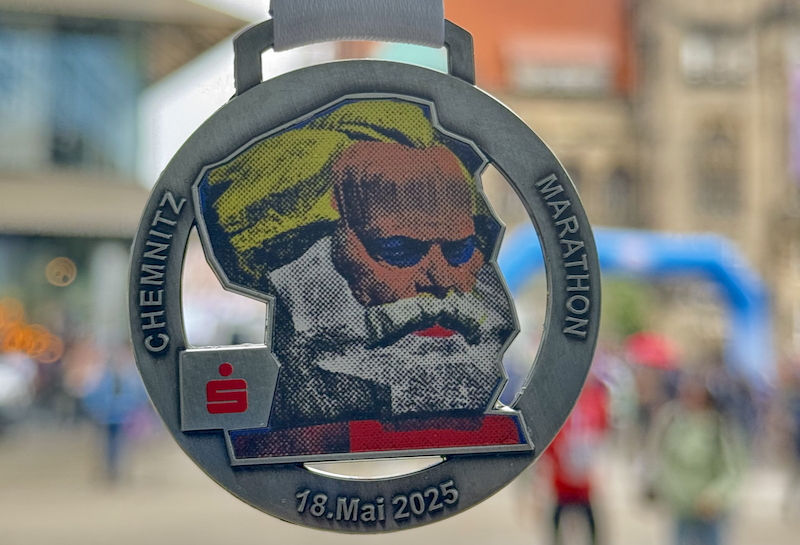
What stood out Good loop of Chemnitz. Crossing downtime four times was great, with plenty of spectators, huge crowds. The medal with the iconic Karl-Marx head is very unique. | |||
*Einzelne Bewertungen: Details siehe unten
Die Bewertungen sind sehr subjektiv sind und basieren nur auf dem letzten Lauf, den ich persönlich durchgeführt habe. Einige Dinge wie das Design der Medaille oder des Finisher-Shirts können von Jahr zu Jahr stark schwanken.
Zuschauer: Wie viele Zuschauer entlang der Strecke? Wie viel Action und willkommene mentale Ablenkung für die Läufer, insbesondere in der zweiten Hälfte der Strecke, wurde geboten? Höhere Bewertungen für mehr Zuschauer, Action, Musik, etc.
Strecken-Verpflegung: Anzahl der Wasserstationen und Vielfalt des Nahrungsangebots.
Medaillen-Design: Wichtige Aspekte für mich: Spiegelt die Medaille in gewisser Weise den Ort oder die Strecke wider? Zeigt sie die Distanz und das Datum der Veranstaltung? Hat sie eine angemessene Größe und Form? Wie kreativ ist das Design? Sieht sie billig aus?
Zeitmessung: Wie viele Zeitmessmatten gab es auf der Strecke? Gab es Zeitmessungsmatten in Schlüsselbereichen, um Abkürzungen zu verhindern und Zeitsplits zu ermöglichen?
Umgebung/Aussicht: Wie viel visuelle Ablenkung und Staunen bekommt man als Läufer auf der Strecke? Normalerweise bieten Ein-Runden- oder Punkt-zu-Punkt-Läufe mehr Abwechslung im Vergleich zu Strecken mit mehreren Schleifen. Ich schätze natürliche Landschaften mehr als Industrie- oder Vorstadtgebiete.
Organisation insgesamt: Wie gut war die Veranstaltung insgesamt organisiert? Inklusive Kommunikation vor und nach dem Event, verfügbare Streckeninformationen, Expo, Neben-Events, Ansagen vor und nach dem Rennen, Start- und Zielbereich, usw.
Finisher-Shirt: Das Design des Shirts, die Art des Stoffes, ist es voll von Sponsoren?
Wertigkeit: What you get vs what you paid. Some races are super expensive and you don’t even get a shirt, others are reasonably priced and even include a pasta party the day before. High ratings either mean cheap entry or lots of goodies.